This project focused on using deep learning for damage prognostics on aircraft engines. The project was part of a computer science course in artificial intelligence and deep learning, which I completed as part of my Master’s degree in Computer Science and Informatics at Roskilde University.
The goal of the project was to predict when aircraft engines are approaching failure, so they can be serviced in time before further breakdowns occur, thereby reducing operational costs.
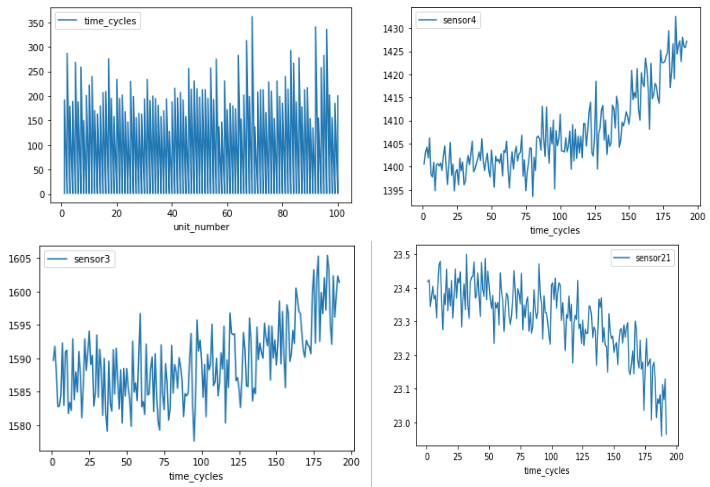
I used deep learning to gain predictive insights by analyzing historical data. The dataset used in this project was the Turbofan Engine Degradation Simulation Data Set from NASA, which includes time-series data from simulated aircraft engines. The images below show some of the sensor readings from the dataset.
I explored multiple deep learning architectures throughout the project. I started with a simple linear regression model and then moved on to experimenting with multilayer perceptrons, recurrent neural networks (RNNs), and long short-term memory (LSTM) networks.
The project was implemented in Python using TensorFlow and the Keras high-level API.